AI Visibility Tracker: what it is, what to track, and how to choose one
The complete guide to tracking how AI answer engines mention, cite and recommend your brand - including a comparison with SEO rank tracking, a buyer's checklist, and the workflow for turning findings into fixes.
Read the guide →What happens to AI answers when you discontinue or rename a product
A discontinued SKU does not leave AI engines when it leaves your catalog, and a new name does not arrive the day you announce it. The actual timeline, and what narrows it.
Read guide →How to price agency work once a client sells more than one product line
A client with three product lines is really three accounts. What changes in pricing, scoping and reporting once AI visibility work has to cover each one.
Read guide →What changed when ChatGPT, Perplexity and Gemini became shopping engines
ChatGPT, Perplexity and Gemini all shipped comparison tables and shopping surfaces in 2026. What actually changed, and what it means for how products get evaluated.
Read guide →Why an AI shopping assistant recommends one of your products and skips the one next to it
Your two product lines get tracked as one score, but an AI shopping assistant is choosing between them every time it answers. What actually decides which SKU wins.
Read guide →What you lose if you switch AI visibility tracking tools mid-year
Switching AI visibility vendors mid-year is more common than it should be in 2026. What actually breaks in the move, and how to switch without losing your trend line.
Read guide →Why AI answers keep citing a price or spec you already fixed on your site
You changed the price on your own site weeks ago, and ChatGPT or Google's AI Overview still quotes the old one. Here is the actual mechanism, and what narrows it.
Read guide →How to price AI visibility work for clients: audit, retainer or results-based
Audits, retainers and results-based fees answer different questions. What to sell first, what breaks against a noisy AI visibility score, and a structure that survives scrutiny.
Read guide →Why your AI visibility score can rise while referral traffic falls
AI visibility scores and AI referral traffic measure different points in the funnel, so they predictably move apart. Here is why, with the data behind it.
Read guide →What listing aggregators like Yext and Data Axle actually fix for AI visibility, and what they don't
A listing aggregator subscription fixes data accuracy across directories. It does not make an AI engine recommend you. Here's the line between the two.
Read guide →Why different AI visibility tools report different scores for the same brand
Two tools tracking the same brand on the same AI engines can report very different numbers. The real causes are prompt sets, engine coverage and weighting, not a wrong tool.
Read guide →Why AI recommendations make your reviews matter more, not less
AI names a business, then the buyer checks the reviews anyway. New survey data on how often that happens, and what it means for where review work actually pays off.
Read guide →What agencies get wrong reporting AI visibility to franchise and multi-location clients
Rolling twelve locations into one AI visibility score hides more than it shows. What to report instead so a franchise client sees the real, uneven picture.
Read guide →The questions worth tracking when your category has ten buyers a week
Standard prompt-set advice assumes search volume that a small local category doesn't have. How to build and size a list of AI questions when your buyers number in the dozens, not thousands.
Read guide →
AI Rank Tracking: What Replaces Position in AI Answers
AI rank tracking borrows a word from SEO that mostly does not survive the move. Here is where position still exists in an AI answer, and what to measure where it does not.
Read guide →
AI Search Tracking: How to Build Numbers You Can Trust
AI search tracking is a sampling discipline, not analytics. Here is what a run has to hold fixed, what to record every time, and how to tell a real move from noise.
Read guide →Why AI recommends one of your locations and ignores the rest
Multi-location brands show up far less than independents in AI answers, and the gap is structural, not per-store. Why location-level measurement is the only honest way to report it.
Read guide →What actually changes when a model updates
Your AI visibility swings and a model update landed the same week. Here's what genuinely moves when engines update, what's measurement noise, and how long to wait before you react.
Read guide →
What are the best AI search visibility tracking tools for 2026?
A neutral look at the main AI visibility tools, grouped by who each one is actually built for. What separates them, what they share, and how to judge them for yourself.
Read guide →
ChatGPT visibility tracker: how to track your brand in ChatGPT
ChatGPT answers from two different places, and they fail differently. What a ChatGPT visibility tracker should actually measure, and what to do with each result.
Read guide →
Gemini visibility tracker: how to track brand visibility in Gemini
Gemini is not one surface. The Gemini app, Google AI Overviews and AI Mode give different answers to the same question. What that means for tracking, and how to avoid the most common measurement error.
Read guide →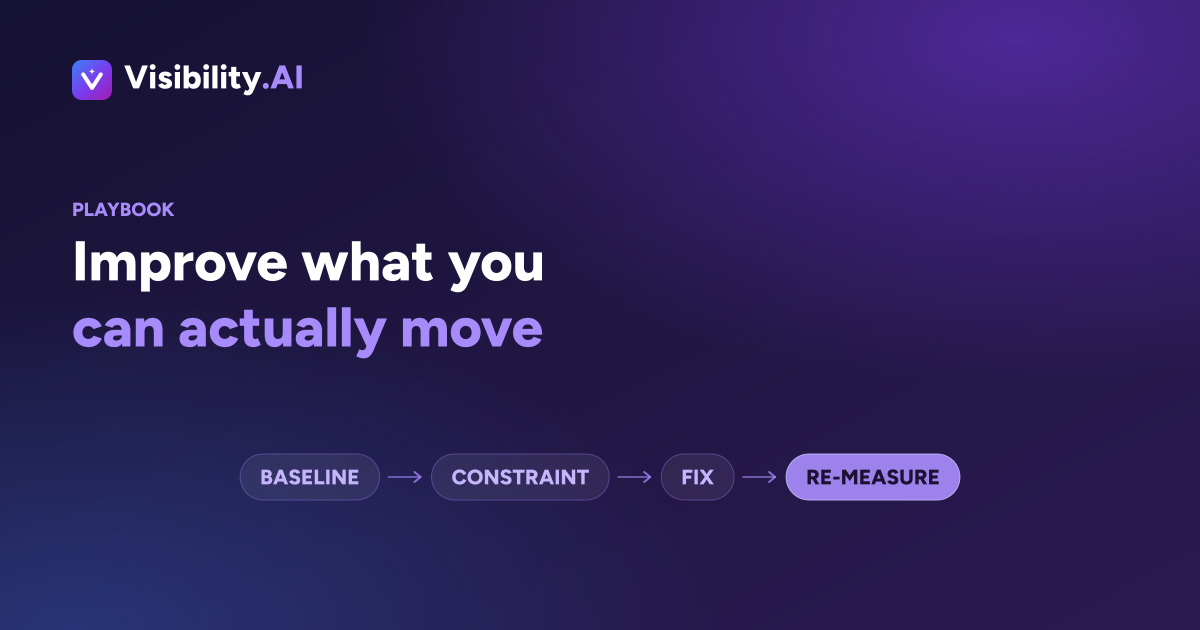
How to improve brand visibility in AI search engines
A sequenced playbook for moving your AI visibility from a real baseline: find the one constraint costing you answers, fix it in leverage order, and re-measure honestly.
Read guide →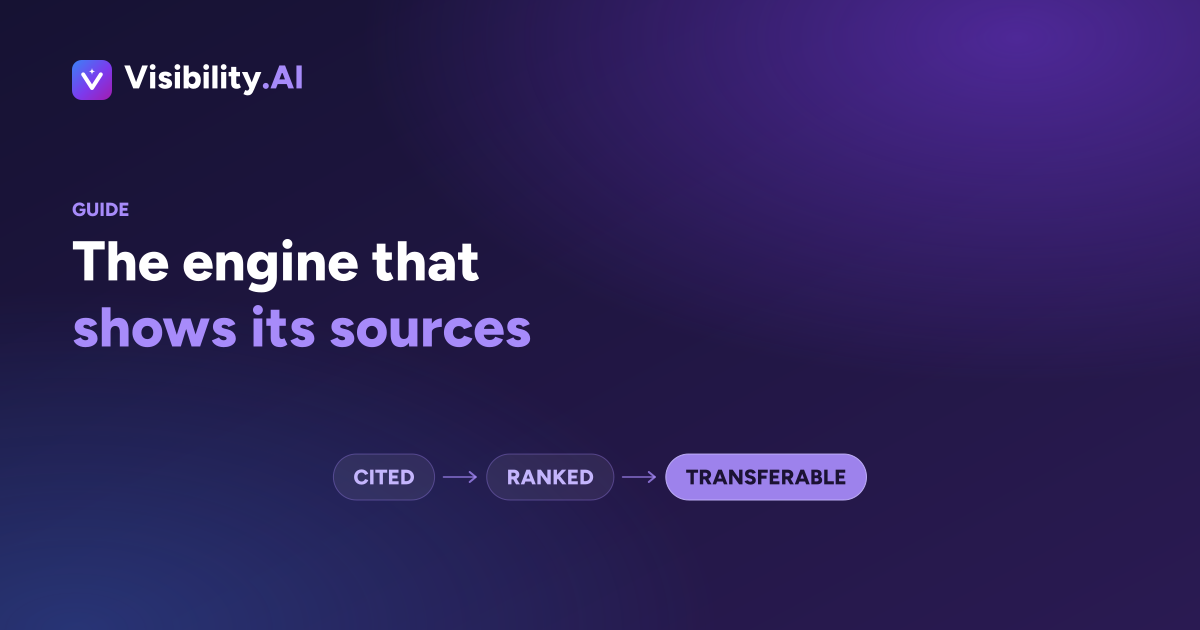
Perplexity visibility tracker: how to track citations in Perplexity
Perplexity cites every answer, which makes it the most legible AI engine to track. How to read those citations, and why what you learn there transfers to engines that hide their sources.
Read guide →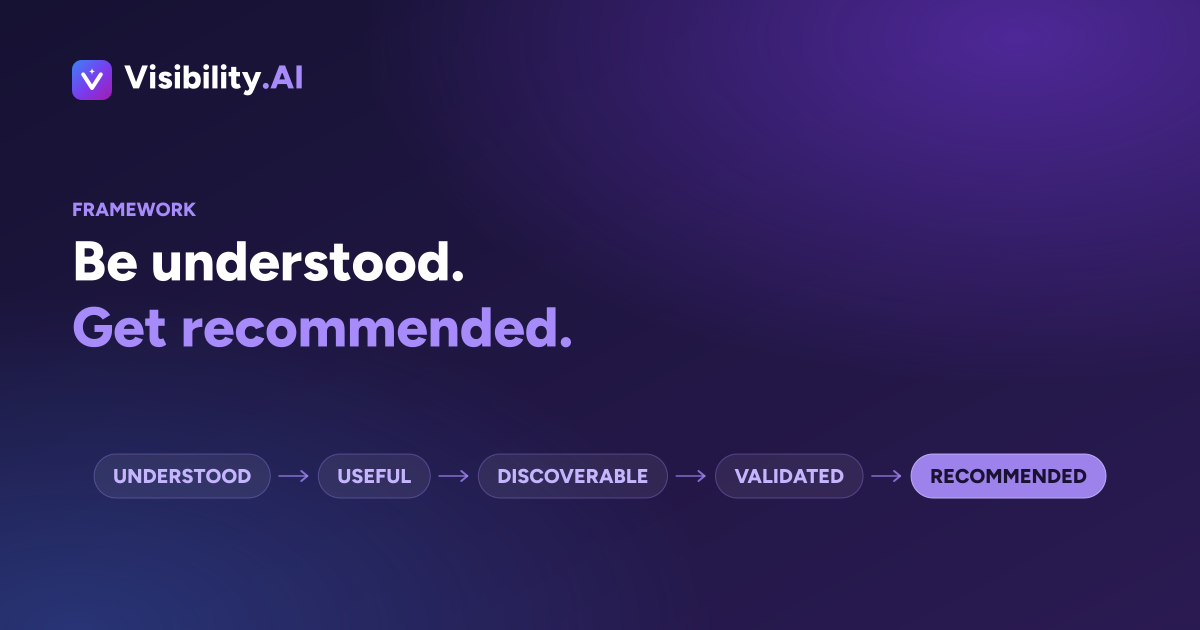
How to get your business into AI answers
Five pillars for getting named in AI answers: be understood, useful, discoverable, validated, recommended. What each one means and the work each takes.
Read guide →
Why AI visibility tools stop at monitoring
Every AI visibility tool monitors. Almost none tell you what to fix. Why the category stops at the dashboard, and the five levels of actually fixing it.
Read guide →
AI visibility audit: a four-layer framework
An AI visibility audit finds why AI engines leave your brand out, and what to fix. Four layers: the answers, the sources, your entity, and your site.
Read guide →
Free AI visibility checker: what it can really tell you
A free AI visibility checker shows whether AI names your brand. How to run one properly, read the result, and know where a single check stops being useful.
Read guide →
AI referral traffic: how to track it in GA4 and logs
AI referral traffic is the visits you get when someone clicks a link in an AI answer. How to separate it in GA4, read it in logs, and what you can't see.
Read guide →
How to track AI visibility: a practical guide
How are you tracking AI visibility? Here's a practical framework: fix your prompts, scan every engine, measure share of voice, and act on the trend.
Read guide →
AI Search Visibility: How to Get Cited in AI Answers
AI search visibility is whether your brand shows up across AI surfaces like ChatGPT, Perplexity and Google AI Overviews. Here's how to audit and improve it.
Read guide →
AI Visibility: The Complete Guide for 2026
AI visibility is the new measure of whether your brand shows up when buyers ask AI. Here's what it is, why it matters, how to measure it, and how to improve it.
Read guide →
Which AI engines should you track in 2026?
Not all answer engines matter equally to your brand. Here's a practical guide to the engines worth tracking in 2026 - and how to decide where to focus.
Read guide →
What is answer engine optimization (AEO)? Understanding AEO for the future of search
AEO is the practice of getting named inside AI answers rather than ranking in a list. What it is, how it differs from SEO, how answers are actually assembled, and what earns a citation.
Read guide →
How to prove the ROI of answer-engine optimization
AEO earns budget when you can show it working. Here's how to measure visibility trends over time, tie citations to outcomes, and report to stakeholders.
Read guide →
From visibility gap to published content: an AEO workflow
Finding a gap is easy; closing it is the work. A repeatable AEO workflow that turns visibility gaps into AI-optimized content that earns citations.
Read guide →
The sources AI engines trust (and how to earn a spot)
AI answers are only as good as the sources behind them. Here's how engines pick citations, how to audit where you're absent, and how to earn presence.
Read guide →
Is AI recommending you - or your competitors?
When an AI names 'the best option,' it's usually not you by accident. Here's how to run a competitor visibility audit and act on the gaps.
Read guide →
How to choose the prompts worth tracking for AI visibility
Your prompt set decides what your AI visibility data is worth. Here's how to pick high-intent questions buyers actually ask, and how many to track.
Read guide →
How to measure your brand's share of voice in AI answers
Share of voice is the clearest scoreboard for AI visibility. Here's what it means in answer engines, how to baseline it, and why it moves.
Read guide →