On this page
- What AI search tracking actually is
- Why it is a survey, not a census
- The unit that makes it comparable
- What to record on every run
- Cadence, and how much movement is noise
- The engines do not behave the same way
- Reading a change without fooling yourself
- Where tracking stops
- Starting from nothing
- Frequently asked questions
Most teams check their AI visibility the way you check a mirror: once, quickly, and usually because something prompted the worry. You type your category question into ChatGPT, read the answer, and either feel fine or do not.
That check is worth doing. It is not tracking, and the difference is not pedantry. A single look tells you what one engine said, on one day, to one phrasing of one question. It cannot tell you whether you are gaining or losing ground, whether the work you did last month moved anything, or whether the competitor named ahead of you is always named ahead of you.
- AI search tracking is sampling, not analytics. No engine publishes what real users asked or saw, so every number is a survey of questions you chose to ask.
- The prompt set drives the number more than anything else. Change the questions and you change the result, which is why prompts have to stay fixed.
- Record the answer, not just a score. Citations and competitor names are the part you can act on.
- Answer engines are non-deterministic. A single run is one sample, and small movements between runs are usually noise.
- Tracking earns its cost only when it changes what you do next. A dashboard nobody acts on is an expensive worry generator.
What AI search tracking actually is
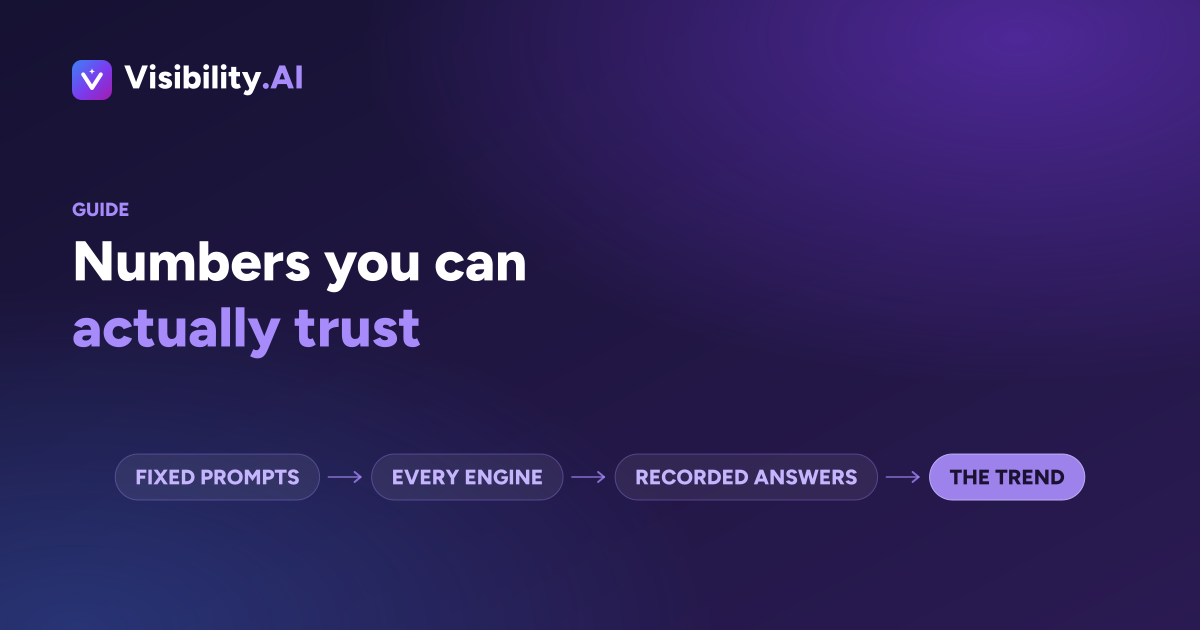
AI search tracking is the practice of asking answer engines a fixed set of questions on a repeating schedule, and recording what comes back in enough detail to compare one run against the next.
That is the whole mechanic. The sophistication is not in the asking, it is in the discipline: the same questions, the same engines, the same cadence, recorded the same way, so that when something changes you can tell whether the change is in the answers or in your measurement.
It exists because the thing it measures has no official reporting. Google Search Console tells you what queries brought people to your site. There is no equivalent for AI answers. Nobody sends you a report saying you were named in a certain number of ChatGPT conversations last week, and the engines have shown no sign of building one.
So the industry does the only thing available: it asks the questions itself and writes down the answers.
Why it is a survey, not a census
This is the part most dashboards are quiet about, and it changes how you should read every number they produce.
When your analytics says a page received a certain number of visits, that is a count of things that happened. When an AI visibility tool says you appear in a certain share of answers, that is a count of things that happened when the tool asked. Real users asked different questions, in different words, with different context and conversation history, on different devices, in different places.
Sampling is a legitimate method. Polling works. But it works because pollsters are careful about who they ask and honest about the margin, and it fails when someone treats the sample as the population.
The practical consequences:
Your number is a property of your prompt set. Two tools tracking the same brand in the same week will disagree if they ask different questions, and both will be right about what they asked. This is the single largest source of variance in the category, larger than engine coverage or scoring method.
A better number can mean better prompts. If someone adds five easier questions to the tracked set, visibility improves without anything changing in the world. This is why the prompt set has to be fixed, and why an “auto-expanding” prompt list quietly destroys comparability.
Absence of evidence is not evidence of absence. Not appearing for the questions you chose does not mean you never appear. It means you did not appear for those questions, on those runs.
None of this makes tracking useless. It makes it a measurement you have to design rather than a report you consume.
The unit that makes it comparable
The useful mental model is a grid. Down one axis, the prompts you track. Across the other, the engines you track. Every cell is one question asked of one engine, and every run fills in the grid again.
That grid is the unit of comparison. As long as its shape stays the same, the numbers on top of it mean something across time: this week against last week, before a piece of work against after it.
Which is why the two axes have to be deliberate rather than accidental.
Prompts should be the questions buyers actually ask, not keywords with question marks glued on. Nobody types “best CRM software 2026 comparison” into ChatGPT. They type something closer to “we are a 12 person agency drowning in spreadsheets, what should we use to track clients”. We wrote separately about how to choose prompts worth tracking, because the choice matters more than the tooling.
Engines should be where your buyers ask, which for most businesses starts with ChatGPT, Google’s AI surfaces and Perplexity, and extends from there based on your audience. Which AI engines to track goes through the reasoning.
Get those two right and the tracking is mostly bookkeeping. Get them wrong and no amount of dashboard polish will rescue the numbers.
What to record on every run
The temptation is to record a score, because a score fits in a chart. A score is also the least actionable thing in the answer.
Here is what is worth capturing every time, roughly in order of how much you will use it.
Whether you were named. The base signal. Present or absent, per prompt, per engine.
Which competitors were named instead. Usually the most useful field in the whole record. “You are absent” is a problem statement. “You are absent and these three are always named” is a research brief, and it tells you exactly whose content the engines currently trust for your category.
Which sources the engine cited. This is the closest thing to a work order that tracking produces. Answer engines are drawing on something, and the pages they draw on are visible on the engines that show sources. If the same three publications keep appearing behind your category’s answers, you have learned where the answer is being formed. We went deeper into this in the sources AI engines trust.
How you were described. Being named is not automatically good. Being named as the budget option when you sell premium, or with a caveat attached, is a different result from a clean recommendation, and only the answer text tells you which happened.
The answer itself. Store it. Scores compress away exactly the detail you need six weeks later when you are trying to work out what changed.
A tracker that gives you a number without the answer behind it has handed you an anxiety, not an input.
Cadence, and how much movement is noise
Answer engines are non-deterministic. Ask the same question twice and you can get materially different answers, with different brands named, without anything having changed on your side or theirs. Some of that is deliberate sampling in how the models generate text. Some is retrieval picking up different sources. Some is the engine being quietly updated.
This has a blunt implication: a single run is one sample, and small differences between two runs usually mean nothing.
Weekly is the cadence that suits most businesses. It is frequent enough that a change can be connected to the work that caused it, and slow enough that you are not reacting to variance. Daily tracking mostly measures the engines’ own noise, at several times the cost. Monthly leaves too much between measurements to attribute anything.
Whatever you choose, hold it steady. An irregular schedule produces a line you cannot read, because you can no longer tell whether a gap represents a change or a missed run.
When you do read the trend, look for direction that persists across several runs rather than movement between two. The question is never “did it move”, because it always moves. The question is “has it been moving the same way for a month”.
The engines do not behave the same way
A tracking system that treats every engine as an identical box to send questions into will produce numbers that quietly mean different things in different columns.
ChatGPT answers from two different places. Sometimes it retrieves and cites live sources. Sometimes it answers from what the model already absorbed during training, with no retrieval at all. Those are different mechanisms with different levers: one responds to publishing and being cited, the other responds to being widely written about over a long period. A tracker that records only “named or not” cannot tell them apart, and the fix for each is different. We pulled this apart in tracking visibility in ChatGPT.
Perplexity shows its work. It cites heavily and visibly, which makes it the most useful engine for diagnosis even if it is not where most of your buyers are. If you want to know which sources shape your category’s answers, this is the cheapest place to find out, and what you learn there usually transfers. More on that in tracking visibility in Perplexity.
Google’s AI surfaces are several things at once. AI Overviews, AI Mode and the classic results page are different surfaces with different behaviour, and they are the place where your existing search rankings genuinely feed the AI answer. Tracking visibility in Gemini and Google’s AI surfaces covers the distinction, which matters because “we track Google” can mean three different things.
The practical consequence for tracking design: do not average across engines and report one number. A single blended visibility score hides the fact that you might be strong on the engine that cites and absent on the engine most of your buyers use. Keep the engines separate in the record, and blend only when someone specifically asks for a summary.
Reading a change without fooling yourself
When the number does shift, there are only a few honest explanations, and it is worth ruling them out in order.
Did the measurement change? A prompt was reworded, an engine was added, the scan failed halfway and got recorded as absence. Measurement changes look exactly like real changes on a chart, and they are far more common than they should be.
Did the engine change? Model updates and retrieval changes move whole categories at once. If every brand you track moved together, you learned something about the engine, not about yourself.
Did a competitor change? Someone else publishing the definitive page on your category question will move you down without you doing anything wrong.
Did your work land? The one everybody jumps to first, and the one worth checking last, because it is only credible once the other three are eliminated.
That order is the difference between a trend you can defend in a meeting and a story you told yourself.
Where tracking stops
Tracking is measurement, and measurement is not improvement. It is genuinely easy to build a habit where a report arrives, gets glanced at, and changes nothing. The number goes up and down, everyone nods, and no work happens.
The point of all this is the decision it produces. A tracked prompt where you are absent and a competitor is consistently named is a content brief. A citation list that keeps naming the same three sources is an outreach target list. A prompt where you appear but are described wrongly is a positioning fix on a page you already own.
If your tracking is not producing that kind of next action, the problem is not the dashboard. It is that nothing downstream is wired to it. We wrote about that gap in why AI visibility tools stop at monitoring.
Starting from nothing
If you have never tracked this, the first useful move is small.
Write down ten questions a real buyer would ask an assistant on the way to choosing something like you. Not keywords. Actual sentences, including the messy context a person would give. Run them across the engines your audience uses. Record, for each one, whether you appeared, who else did, and what was cited.
That is your baseline. It will probably be worse than you expect, which is the normal result and the reason the exercise is worth doing.
Then run the same ten next week, unchanged, and the week after. The first run tells you where you stand. The fourth tells you which direction you are moving, and that is the number that actually informs anything.
You can do this by hand at the start, and doing it by hand once is genuinely instructive. It stops scaling around the point where you are copying answers into a spreadsheet on a Monday morning and quietly deciding to skip a week. That is what our tracker automates, and if you want to see the shape of the output before deciding anything, the free check runs the same idea against your own brand.
Frequently asked questions
What is AI search tracking?
Asking answer engines a fixed set of questions on a schedule and recording what comes back: whether your brand is named, which sources the engine cited, and which competitors appeared instead. It is how you turn a one-off check into a trend you can act on.
Is AI search tracking the same as analytics?
No, and the difference matters. Analytics reports what real people did. AI search tracking samples what an engine says when it is asked, because no engine publishes brand-level data about what real users asked or saw. It is a survey, not a census, and every number it produces is a sample.
How often should I run a scan?
Weekly suits most businesses. Daily produces movement you cannot act on and mostly measures the engines' own variance; monthly is too slow to connect a change to the work that caused it. Run on the same cadence every time, because an irregular schedule makes the trend unreadable.
Why do two tools give different answers for the same brand?
Because they asked different questions. The prompt set is the single biggest driver of any AI visibility number, larger than engine coverage or scoring method. Two tools with different prompts will disagree, and neither is wrong about what it asked.
How much movement counts as a real change?
Less than you would expect. Answer engines are non-deterministic, so the same prompt asked twice can differ without anything changing on your side. Treat a single run as one sample, and look for a direction that holds across several runs before concluding anything.
Can I track AI search visibility manually?
You can start that way, and it is a reasonable way to learn what the answers look like. It stops scaling quickly: a handful of prompts across several engines, repeated weekly, with citations recorded per answer, is hours of copy and paste a week and a spreadsheet nobody updates by month three.